

Working from home is no longer a temporary arrangement for many families in Burlington, Oakville, Mississauga, and across the GTA. Yet plenty of people are still working from the dining table or a corner of the bedroom. A home office renovation in the GTA turns that compromise into a quiet, comfortable, well-lit space built for real work—and it can add everyday value to your home.
This guide covers the most popular home office renovation ideas, how to convert a spare bedroom, basement, or garage, the electrical and tech upgrades worth planning for, Ontario permit basics, and what to expect for costs and timelines.
Why a Dedicated Home Office Adds Value to Your GTA Home
A dedicated office is one of the most practical upgrades you can make to a GTA home today.
Productivity and boundaries
A room with a door gives you somewhere to focus—and somewhere to leave at the end of the day. Separating work from family space helps with both concentration and work-life balance.
Appeal to future buyers
Hybrid work is here to stay for many professionals, and buyers often look for a space that can serve as an office. A finished, well-planned office (or flex room) can help your home stand out when it’s time to sell.
Better use of underused space
Many homes have a spare bedroom used for storage, an unfinished basement corner, or a garage that holds more clutter than cars. A home office renovation in the GTA turns that square footage into space you use every day.
Popular Home Office Renovation Ideas
The best offices are designed around how you actually work. Here are the upgrades homeowners ask us about most.
Built-in desks and storage
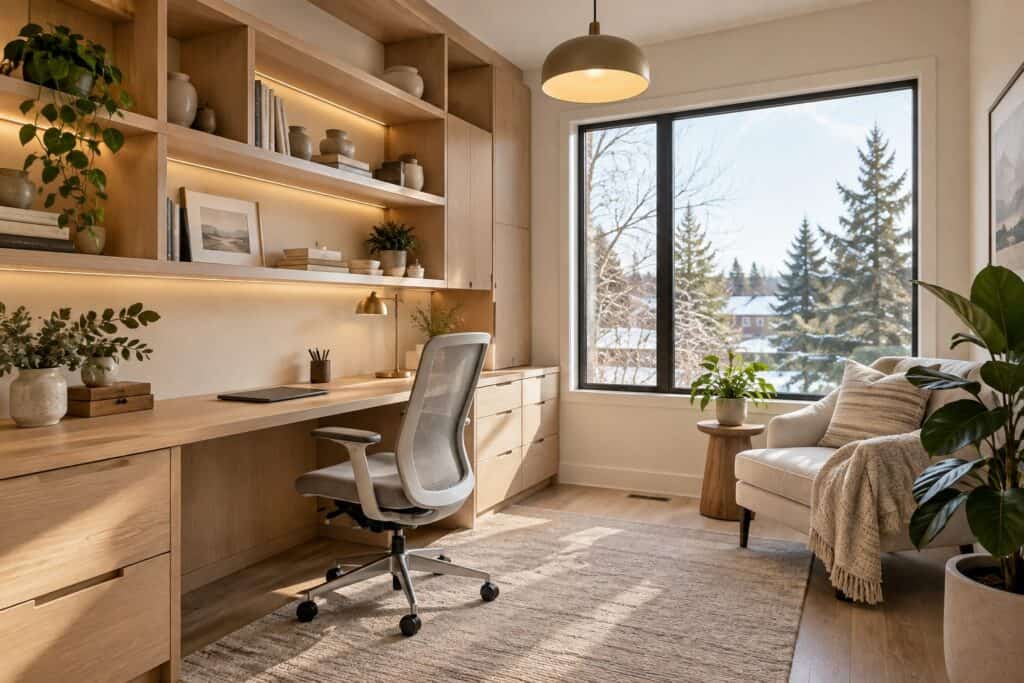
Custom built-ins make the most of every inch. A wall-to-wall desk with overhead shelving, drawers for files, and a closed cabinet for the printer keeps the room tidy and camera-ready. Built-ins also look more permanent and finished than freestanding furniture.
Soundproofing and acoustics
If you’re on video calls all day, sound matters. Options include insulating interior walls with sound-dampening batts, installing a solid-core door with weatherstripping, and adding soft finishes such as rugs, upholstered seating, and acoustic panels to cut echo.
Layered lighting
Good lighting reduces eye strain and makes you look better on camera. Plan for three layers:
- Ambient – recessed pot lights or a ceiling fixture for overall light
- Task – under-shelf LEDs or a desk lamp over your work surface
- Natural – position the desk to use window light without glare on the screen
Comfortable flooring and finishes
Engineered hardwood, luxury vinyl plank, or laminate are durable choices that roll well under an office chair. For basement offices, choose moisture-tolerant products.
Climate control
Home offices can run hot with computers and closed doors. Make sure the room has a proper supply and return vent, or consider a ductless mini-split for rooms that are hard to heat and cool.
Dual-purpose and flex rooms
Not every home has a room to dedicate to work full time. A Murphy bed paired with a built-in desk turns a guest room into an office most of the year. Pocket doors, a wall of closed cabinetry that hides equipment after hours, and a fold-down desk in a hallway niche or under the stairs are all smart ways to create a work zone without giving up a bedroom. In smaller GTA homes and townhouses, these flexible designs often deliver the best return on space.
Colour and finishes that support focus
Soft neutrals, muted greens, and warm whites create a calm backdrop for long workdays and look professional on camera. A feature wall behind your desk—painted, panelled, or lined with shelving—adds personality to your video call background.
Converting a Spare Bedroom, Basement, or Garage Into an Office
Where you put your office will shape the budget and the scope of work.
Spare bedroom
This is usually the simplest option. The room already has heat, windows, and a door. Most projects focus on built-ins, lighting, electrical, flooring, and paint.
Basement
A basement office offers privacy and separation from household noise. It’s often part of a larger finishing project—see our basement renovation ideas for the GTA for inspiration. Key considerations include moisture control, insulation, ceiling height, and adding enough light. Egress windows are required if the space will ever be used as a bedroom.
Garage
A garage conversion creates a truly separate workspace, which is ideal if clients visit. It’s also the most involved option: you’ll typically need to insulate walls and ceiling, raise or insulate the floor, add heating and cooling, and replace the garage door with a wall and windows. Garage conversions almost always require a building permit, and some municipalities have parking requirements to consider.
Electrical and Tech Upgrades
Plan these early. They’re much easier to install while walls are open.
More outlets in the right places
Add outlets at desk height and along the walls where equipment will live. Consider outlets with built-in USB-C charging. A dedicated circuit is worth considering if you run multiple monitors, a printer, and a space heater at once.
Wired internet and networking
Wi-Fi is convenient, but a wired Ethernet connection is more stable for video calls. Running network cable to the office during the renovation costs far less than retrofitting it later. A central spot for your router or a mesh access point also helps.
Lighting controls
Dimmers and smart switches let you adjust lighting for focused work, video calls, or evening use.
Surge protection and backup
Whole-home surge protection or a quality surge protector, plus a small battery backup (UPS) for your computer and modem, protects your work during summer storms.
In Ontario, electrical work generally requires a permit from the Electrical Safety Authority (ESA) and should be done by a licensed electrical contractor.
Permit Requirements for Home Office Renovations in Ontario
Whether you need a building permit depends on the scope of the work. Cosmetic updates—paint, flooring, and freestanding furniture—typically don’t require one. You’ll usually need a building permit if the project involves:
- Moving, removing, or adding walls
- Finishing a basement or converting a garage
- Adding or changing plumbing (such as a powder room)
- Altering HVAC ductwork
- Installing new or enlarged windows or doors
Electrical work is permitted separately through the ESA. For a full breakdown, read our guide on whether you need a permit for home renovations in Ontario. Requirements vary by municipality, so always check with your local building department—or let your contractor handle it.
Typical Costs and Timelines
Every home is different, so treat these as general ranges rather than quotes. Your final cost will depend on the size of the room, the finishes you choose, and what’s behind the walls.
| Project type | Typical scope | Typical timeline |
|---|---|---|
| Spare bedroom refresh | Paint, lighting, flooring, outlets, simple built-in desk | 1–3 weeks |
| Custom spare bedroom office | Full built-ins, soundproofing, new electrical and networking | 3–6 weeks |
| Basement office (as part of finishing) | Framing, insulation, drywall, flooring, electrical, HVAC | 6–12 weeks |
| Garage conversion | Insulation, floor, windows, wall, HVAC, electrical, permits | 8–14 weeks |
Custom millwork and permit approvals are usually the biggest variables in the timeline. Ordering built-ins and submitting permits early keeps your project on schedule.
FAQ
How much does a home office renovation cost in the GTA?
It depends on scope. A cosmetic refresh of a spare bedroom costs far less than a garage conversion that needs insulation, windows, heating, and permits. The best way to get an accurate number is an on-site consultation.
Do I need a permit to turn a bedroom into an office?
Usually not, if you’re only changing finishes and furniture. You’ll likely need permits if you move walls, change plumbing or HVAC, or add electrical circuits.
Is a basement or spare bedroom better for a home office?
A spare bedroom is typically faster and less expensive. A basement offers more privacy and space but needs good lighting, moisture control, and insulation to feel comfortable.
Can a home office increase my home’s value?
A well-finished, flexible room that works as an office or bedroom can make your home more appealing to buyers, especially those working hybrid schedules.
How long does a home office renovation take?
Simple updates can be done in one to three weeks. Basement offices and garage conversions typically take two to three months, including permits.
Plan Your Home Office Renovation With Domilya Group
A thoughtful home office renovation in the GTA gives you a space that supports your workday and adds lasting value to your home. From built-in desks and soundproofing to full basement and garage conversions, Domilya Group handles the design, permits, and construction so you can focus on your work.
Ready to get started? Contact Domilya Group to book a consultation, or explore our custom home renovation services.